

Where social Communication Happens
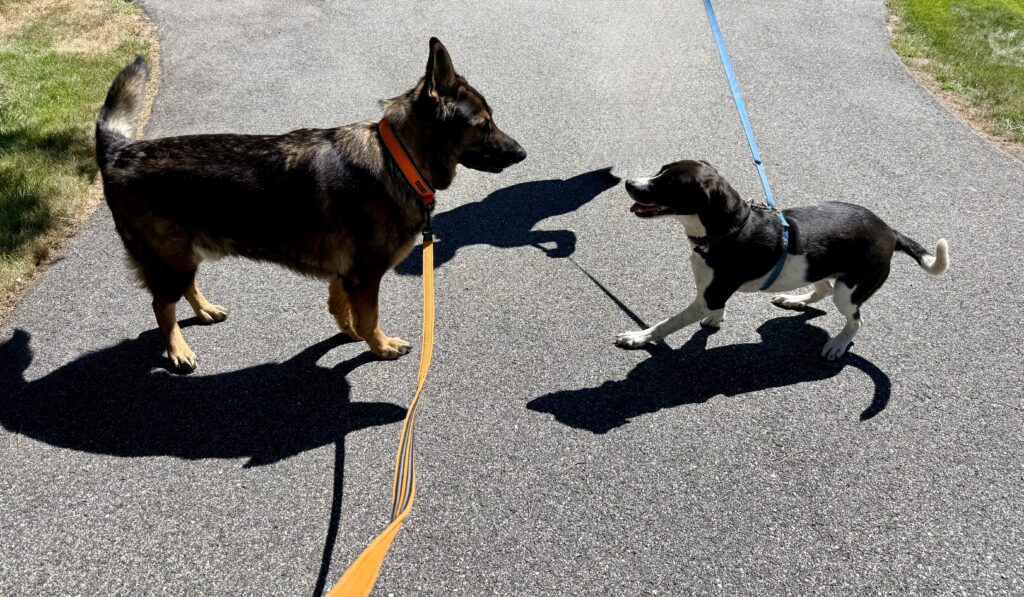
The first few moments are so important. Everyone was watching for play. I was watching the pause from one dog. My German Shepherd, Drake, was greeting a smaller black-and-white dog. As the two considered each other, my attention settled on the black and white dog’s slight hesitation. She leaned back just a little, a subtle shift that would have been easy to miss while waiting for a play bow or a wagging tail. Drake stood balanced, allowing her time without pressing closer. That mattered. Her hesitation seemed to say, “I need another moment,” and his stillness gave her room to take it.
Their open mouths and neutral tails, considered alongside the rest of their body language, gave me reason to be hopeful. There was potential for friendship here, if we allowed the greeting to unfold at her pace. If Drake moved in too quickly, she might pull away or freeze, making her discomfort more visible. For now, there was no need to hurry. Before there could be play, there needed to be time to assess, respond, and choose whether to come closer.
The space between two dogs is where social communication happens. I was watching how they “felt” about each other.
We Tend to Watch for barking and growling
When we watch dogs greet, our attention often goes to the signals we recognize: barking, growling, wagging tails, showing teeth, or sniffing. These are important, but they are only part of the conversation. We can become so focused on what each dog is doing that we miss how they are responding to one another. Who moves closer? Who pauses or leans away? Does one dog allow the other time and space, or keep closing the distance?
What I was observing was the relationship between posture, movement, and space—the three elements of The Space Between Triangle. Her slight backward lean, Drake’s balanced stillness, and the space he allowed her all helped me understand how the greeting was unfolding. Together, these elements revealed a quiet conversation before either dog took another step.
The Real Conversation
A greeting is a conversation that changes with each response. One dog approaches; the other pauses. A movement slows, an invitation is offered, or a little more distance is created. Through these adjustments, dogs negotiate how close to be, how quickly to move, and whether to continue the interaction. The space between them is dynamic, shaped by what both dogs do next.
As we gave the smaller dog time, her behavior began to change. Her earlier hesitation gave way to excitement, and then came the zoomies, a burst of movement that appeared to help her release some of that rising tension. This was encouraging for both me and her handler. We were seeing a change from her initial backward lean to more active movement.
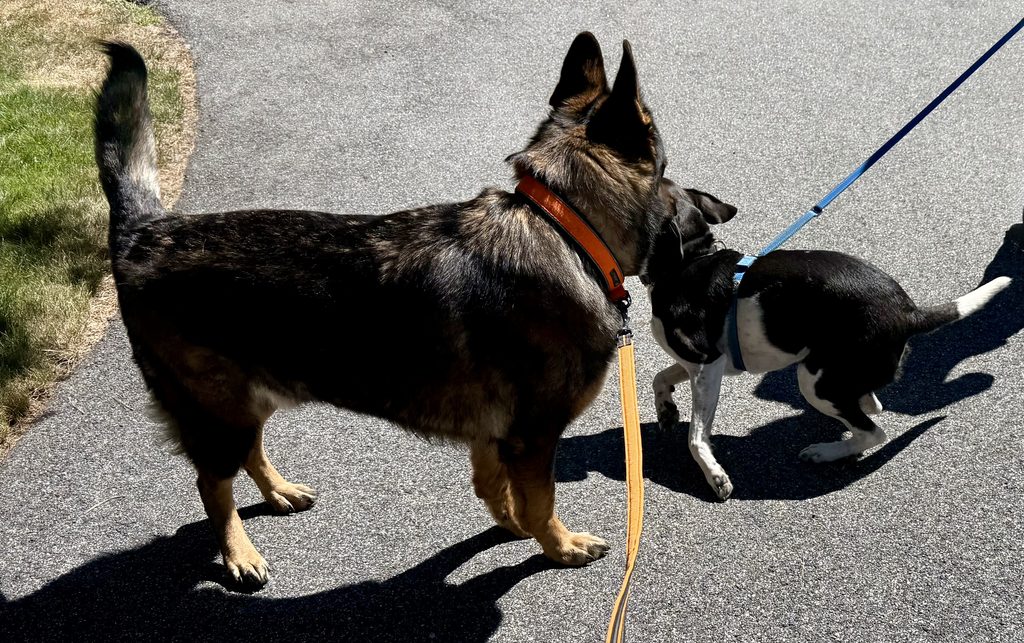
Zoomies alone would not tell me she was comfortable. I still wanted to watch how Drake responded, whether she chose to come closer again, and whether both dogs could pause or move away when they needed to. Her burst of energy was another part of the conversation, but I wanted to still give her time.
Every Step Changes the Conversation
A step closer can be an invitation. It can also create pressure. The difference depends on how the other dog responds. If one dog approaches and the other leans away, continuing forward may ask for more closeness than that dog is ready for. Slowing down or pausing gives the hesitant dog time to assess the interaction. A step away can create room for that dog to approach by choice.
This was why Drake’s stillness mattered. Moving closer might have changed the smaller dog’s response. By allowing the pause, he gave her time to decide what to do next. I look for these exchanges throughout a greeting. When one dog slows, does the other slow too? When one turns away, does the other allow that distance?
When an invitation is offered, is it accepted, declined, or met with hesitation? Curiosity and uncertainty can exist within the same interaction. What matters is whether the dogs can adjust to each other.
Why Emotional Safety Matters
A greeting involves more than deciding whether to play. Each dog is gathering information about the other: how they approach, how quickly they move, and how they respond to a request for space. We might think of the questions this way: “Can I move away? Will you give me time? Can I come closer without being overwhelmed?” With the smaller dog, I wanted her to have time to answer those questions through experience.
Her zoomies were a change worth noticing, but I was still interested in what happened afterward. Would she choose to approach Drake again? Would he continue to give her room? A successful greeting does not have to end in play. Two dogs may briefly investigate each other and then move on. Being able to approach, pause, or leave without being pressured is a valuable social experience in itself.
Making Sense of What We See: The Moore S.C.A.L.E.™
My purpose in creating the Moore S.C.A.L.E.™ was to help people make sense of these interactions. A bark, a wag, or a moment of hesitation tells us more when we consider it alongside the dog’s posture, movement, and use of space—and the other dog’s response. The Moore S.C.A.L.E.™ describes eleven greeting styles, offering a way to explore differences in how dogs approach and respond to one another. These styles give us a starting point for observation. We still need to watch the individual dogs and how their interaction unfolds.
Want to explore these conversations more deeply? In The Space Between Dogs, I introduce the Moore S.C.A.L.E.™ and eleven greeting styles to help you better understand how dogs approach and respond to one another. Explore the The Space Between Dogs found on Amazon.
Seeing Dogs Differently
Everyone watching Drake and the smaller dog could see the same greeting. My attention was on the small exchanges that helped me decide whether to give them more time: her backward lean, his balanced pause, and her change in movement. The next time your dog meets another dog, watch what happens after the first approach. Does one dog hesitate? Does the other adjust? Is there room to move away—and an opportunity to return by choice? Alongside “Are they getting along?” ask, “How are they responding to each other?”
That is where the space between dogs begins to tell its story.
What Is Your Dog Saying During Greetings?
Learn to notice the subtle signals dogs exchange when they meet. Sign up for my emails to receive your free Dog Greeting Decoder, along with insights to help you better understand your dog.
Send Me the Free Dog Greeting Decoder