

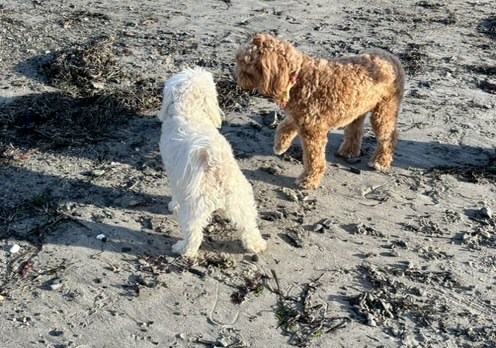
Just this week, I found myself explaining to clients that their sweet dogs didn’t need more socializing. They needed more space and time to feel safe.
Their intentions were loving. They wanted their dogs to have friends, enjoy exercise, and feel comfortable around other dogs. Off-leash parks offered opportunities to meet dozens of dogs, and more social experience seemed like a good thing.
But now, on leash, those same dogs were showing threatening behaviors when passing other dogs.
Their owners were understandably confused. How could a dog who has spent so much time around dogs be struggling to walk past one?
Sometimes, the answer is that the dog has experienced more social pressure than they could comfortably process.
When “more” becomes too much
We often talk about socialization as though every encounter adds something positive to a dog’s life. But being surrounded by dogs doesn’t tell us whether a dog feels comfortable with them.
A dog may enjoy a familiar friend while feeling uncertain about unfamiliar dogs approaching quickly. They may want companionship but struggle with persistent sniffing, rough play, or repeated interruptions when they try to move away.
At an off-leash park, each new arrival can bring another social decision: Will this dog listen to me? Can I move away? Will I have to defend my space?
When I describe a dog as “over-socialized,” I mean they have experienced more interaction, intensity, or social pressure than they were ready to handle. The number of dogs matters less than how those encounters felt.
Over time, a dog may begin anticipating pressure whenever another dog appears.
On leash, where their ability to move away is limited, that concern may become much more visible. Stiffening, growling, barking, or lunging can become ways of asking for distance.
This is one possible pathway to leash reactivity. Understanding the individual dog and their history still matters.
Social interest and social confidence are different
One distinction I explore in The Space Between Dogs is the difference between wanting companionship and feeling confident during a social encounter.
A dog can enjoy other dogs and still lack the social confidence to navigate an unfamiliar greeting.
That dog may need a carefully chosen companion, a slower introduction, and the opportunity to observe before participating. Repeated encounters with compatible dogs may offer far more value than meeting a new group every day.
The Moore S.C.A.L.E.™ helps us look more thoughtfully at these differences in greeting styles, social confidence, and compatibility.
The question becomes: What kind of social experience can this dog comfortably handle—and benefit from?
Listen before the barking begins
Dogs often communicate their uncertainty long before their behavior becomes difficult for us to manage.
In my book, I encourage readers to observe posture, movement, and space together.
Does your dog’s body soften as the other dog approaches, or become more rigid? Do they move forward with loose curiosity, hesitate, or turn away? When they create distance, does the other dog allow it?
A dog who pauses, curves away, or returns to your side may be asking for more time. If we keep encouraging the greeting, we can unintentionally overlook that request.
No single movement tells the whole story. Watch the sequence, the setting, and how both dogs respond to each other.
When we listen to quieter communication, our dogs have less reason to become louder.
What your dog may need now
If your dog is becoming more uncomfortable around other dogs, consider reducing the social demands you place on them.
- Pause busy group outings. Give your dog a break from settings where unfamiliar dogs can repeatedly enter their space.
- Allow observation without a greeting. Choose enough distance for your dog to notice another dog while remaining comfortable and able to disengage.
- Choose companions thoughtfully. Look for dogs who respect pauses, respond to requests for space, and have a compatible interaction style.
- Leave room for recovery. Notice whether your dog settles afterward or remains watchful, tense, or easily startled.
Success might look like watching a dog from across a field and then returning to sniffing. It might be a quiet walk with one familiar companion. It might simply be discovering that you will help protect their space.
Safety gives connection room to grow
These families weren’t failing their dogs. They were following advice many caring owners receive: socialize more.
What their dogs needed was someone to recognize when more had become too much.
That is at the heart of The Space Between Dogs: learning to see the emotions and communication within an interaction so we can make more thoughtful choices.
Your dog does not have to greet every dog to have a fulfilling social life.
Sometimes, the most helpful thing we can offer is enough space to feel safe—and enough time for trust to grow.
For more guidance on reading canine communication and choosing supportive social experiences, explore The Space Between Dogs: Healing Reactivity through the Moore S.C.A.L.E.™ and the Let’s Talk Process™.